Emergency fund: how much to save, where to keep it and how to start from zero
In this article
A broken car, a layoff, a toothache, a dead fridge. Emergencies never call ahead — and people without savings end up paying with credit cards or overdrafts, some of the most expensive debt there is. An emergency fund is money set aside for exactly that: protecting you from surprises without starting a snowball of interest.
In this guide you will learn how to size your emergency fund, where to keep the money and how to build a realistic plan, even if you start small.
Quick summary: a good emergency fund covers 3 to 12 months of living costs, sits somewhere safe and quick to access, and comes before any other investment.
What an emergency fund is (and is not)
An emergency fund is money kept only for real emergencies: loss of income, health problems, urgent repairs. It is not for vacations, Black Friday or "great opportunities".
It is also not an investment meant to earn a lot. Its job is to be there when you need it, with its value intact. That is why safety and quick access matter more than returns.
How much to save: 3 steps
1. Find your monthly living costs
Add up what you actually spend in a normal month: rent or mortgage, utilities and internet, groceries, transport, health, school, fixed installments. Leave out what you would cut in a crisis (eating out, extra subscriptions, impulse buys).
If you do not know your spending, track everything for 30 days or average the last 3 months of statements. The 50/30/20 rule article helps you organize this.
2. Choose how many months of cover
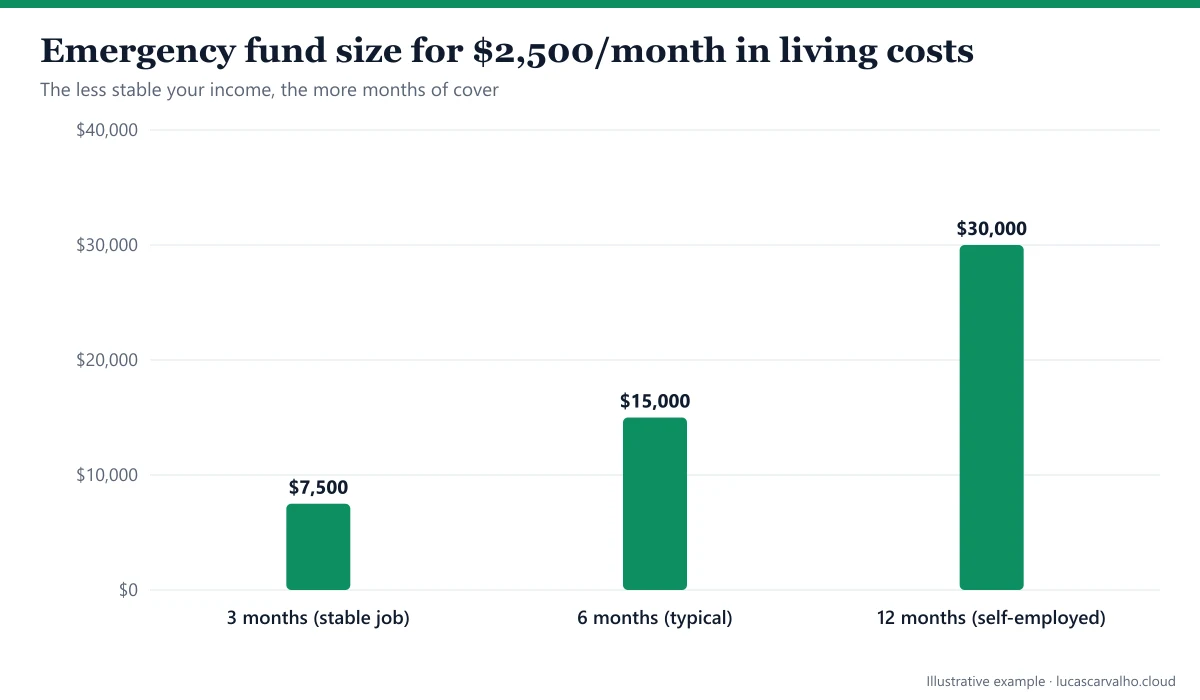
The less stable your income, the bigger your fund should be:
| Your situation | Months of cover | Why |
|---|---|---|
| Salaried with a stable job | 3 to 6 months | Unemployment benefits may help |
| Average income, family with kids | 6 months | More people relying on you, more surprises |
| Self-employed, freelancer, commission | 6 to 12 months | Income varies and there may be no unemployment benefit |
| Very stable public-sector job | 3 months | Low risk of losing income |
3. Multiply
Emergency fund = monthly living costs × number of months.
Example: someone spending $2,500 a month needs:
Where to keep your emergency fund
The right place has three qualities:
- Safety: very low risk of losing money.
- Daily liquidity: you can withdraw the same or next day, with no penalty.
- Returns that keep up with inflation: so idle money does not lose purchasing power.
Options that usually meet these requirements (general information, not a recommendation):
- High-yield savings accounts at insured banks.
- Money market funds or accounts with daily access.
- Short-term government bonds or floating-rate government securities that can be sold quickly.
What to avoid for an emergency fund: stocks, real estate funds, crypto, retirement accounts with withdrawal penalties and anything with a lock-up period. They may earn more over the long run, but they can be down on exactly the day you need the cash.
Tip: keep the fund in a separate account from your everyday account. Out of sight, out of temptation.
How to build it from zero
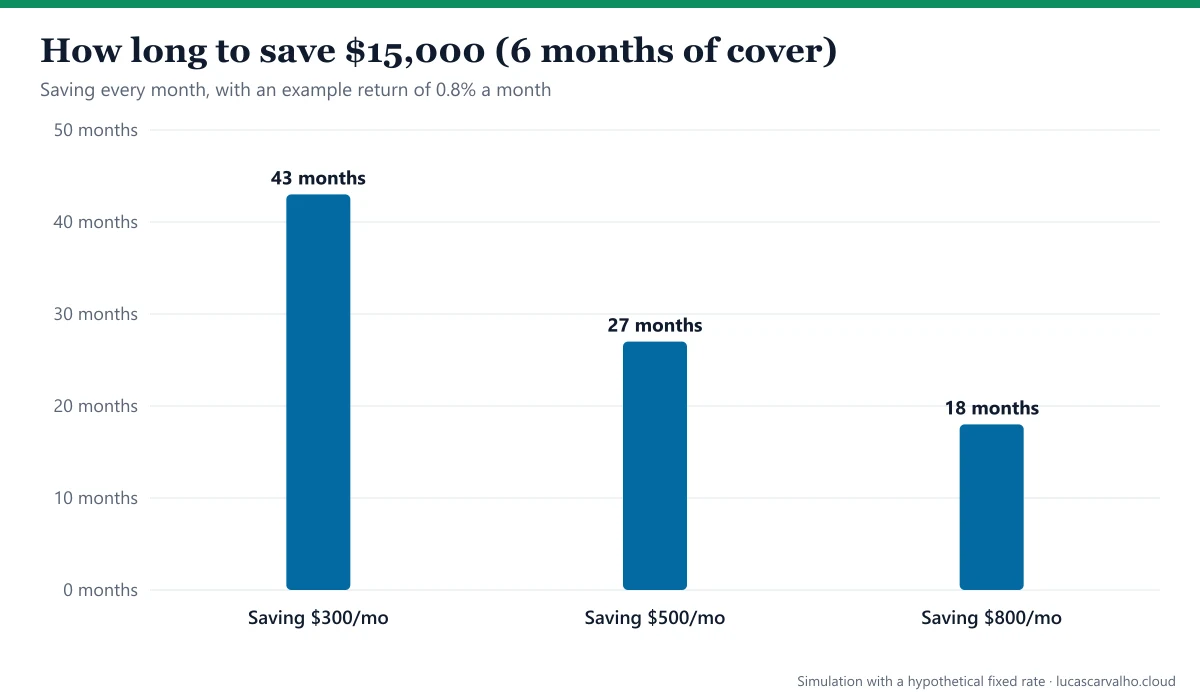
Saving $15,000 looks impossible as one big number. The trick is to turn the goal into monthly installments and let time help. Here is how long it takes to reach $15,000 (6 months of $2,500 costs) saving every month, with an example return of 0.8% a month:
A 5-step plan
- Start with a mini-goal: save 1 month of living costs first. That already covers most surprises and builds momentum.
- Pay yourself first: on payday, move the savings amount before paying anything else. Automate the transfer.
- Use extra money: bonuses, tax refunds, selling things you do not use — all of it can speed up the fund.
- Cut what you will not miss: review subscriptions, bank fees and phone plans. Every $50 saved per month becomes $600 a year.
- Used it? Refill it: if you dip into the fund, go back to saving until it is full again.
Emergency fund or paying off debt first?
It depends on the debt:
- If you have expensive debt (revolving credit card balances, overdrafts, high-interest personal loans), the usual priority is a 1-month mini-fund, then focusing on paying those debts down. Their interest is far higher than anything your savings earn.
- If your debt is cheap and under control (an affordable loan payment), you can build the full fund while paying installments as usual.
Common mistakes
- Buying stocks before having a fund: the first emergency may force you to sell at a loss.
- Leaving it in a checking account: with no interest, inflation eats it.
- Using it for wants: trips and new phones deserve their own savings goal.
- Choosing a locked investment: emergencies do not wait for maturity dates.
- Never updating the amount: if your costs went up, your fund should too.
FAQ
Should I finish my emergency fund before investing? Generally, yes: it is the foundation. Once it is ready, you can invest long term without fear of selling at the wrong time.
Can I split it across places? Yes. Many people keep part with instant access and the rest in a daily-liquidity option.
It earns little. Isn't that wasted money? No. It is insurance: its real "return" is avoiding double-digit interest on cards and overdrafts.
Next steps
With your fund under way, the next step is a budget that leaves money every month — see the 50/30/20 rule — and understanding how compound interest grows that money over time.
Note: this article is educational and is not a recommendation to buy or sell any investment. Figures and rates are examples and may change. Financial decisions are personal — if needed, talk to a certified professional.