Compound interest: what it is, how to calculate it and why time beats amount

In this article
Compound interest is often called "the eighth wonder of the world" (the quote is usually credited to Einstein, though there is no proof he said it). Exaggeration or not, the idea behind it is powerful: when interest earns interest, money grows faster and faster. And the same effect that grows an investment is what makes credit card debt explode.
In this article you will understand the concept with examples, see the formula without the headache and find out why time is the most important ingredient.
All examples use hypothetical fixed rates, before tax and inflation, just to show the effect. In real life, returns vary.
Simple vs compound interest
- Simple interest: interest is always calculated on the initial amount. Invest $10,000 at 1% a month and you earn $100 every month, forever.
- Compound interest: each month's interest is added to the balance, and the next month earns on that new total. You earn $100 in month one, $101 in month two, $102.01 in month three — and so on.
The difference looks small at first. But look at 10 years:
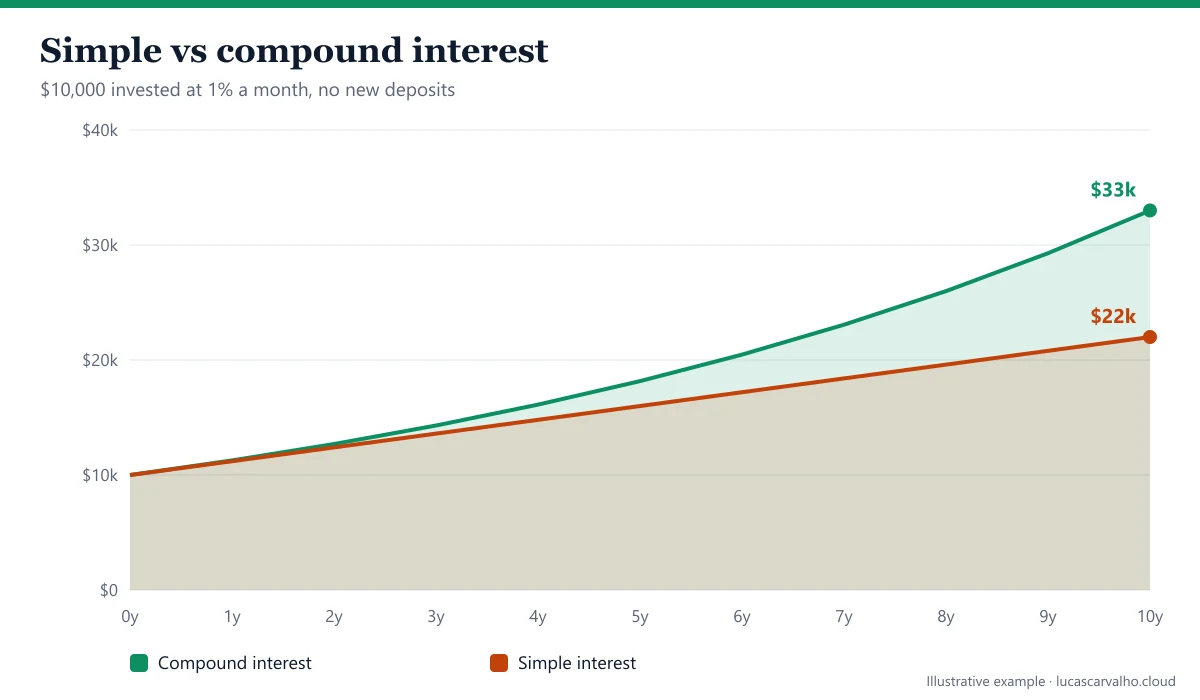
With simple interest, $10,000 becomes $22,000. With compound interest, it becomes about $33,000 — 50% more, without adding a cent.
The formula (no fear)
For a one-time deposit:
FV = P × (1 + r)ⁿ
- FV = future value
- P = principal (amount invested)
- r = interest rate per period, as a decimal (1% = 0.01)
- n = number of periods (months or years, matching the rate)
Example: $10,000 at 1% a month for 120 months → FV = 10,000 × 1.01¹²⁰ ≈ $33,004.
If you deposit a fixed amount every month (payment A):
FV = A × [(1 + r)ⁿ − 1] ÷ r
No need to memorize it: any spreadsheet does it. In Google Sheets or Excel, use =FV(rate, periods, -payment) — for example, =FV(0.8%, 360, -200).
The power of monthly deposits
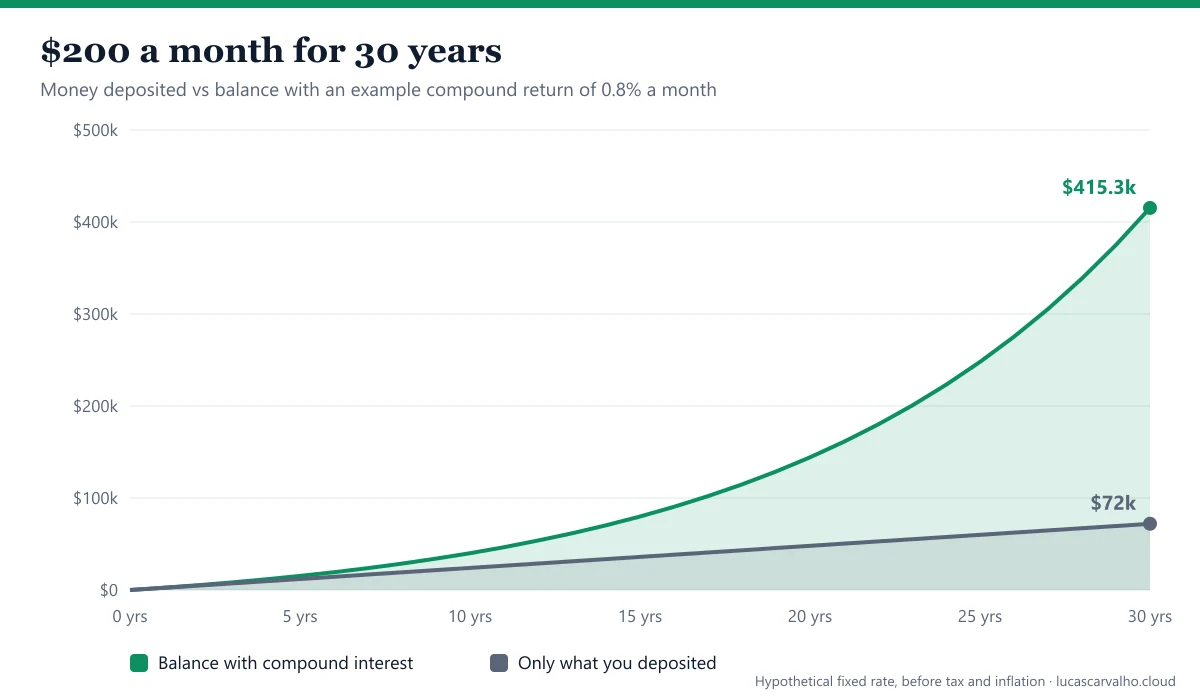
Now a more realistic example: saving $200 a month at an example return of 0.8% a month (about 10% a year):
| Time | Total deposited | Balance with interest | Share from interest |
|---|---|---|---|
| 10 years | $24,000 | $40,043 | $16,043 (40%) |
| 20 years | $48,000 | $144,226 | $96,226 (67%) |
| 30 years | $72,000 | $415,283 | $343,283 (83%) |
Notice: in the first 10 years, interest is less than half the balance. After 30 years, over 80% of the money came from interest. That is why the chart looks like a curve that "takes off" at the end — and why patience matters so much.
Starting early beats saving a lot
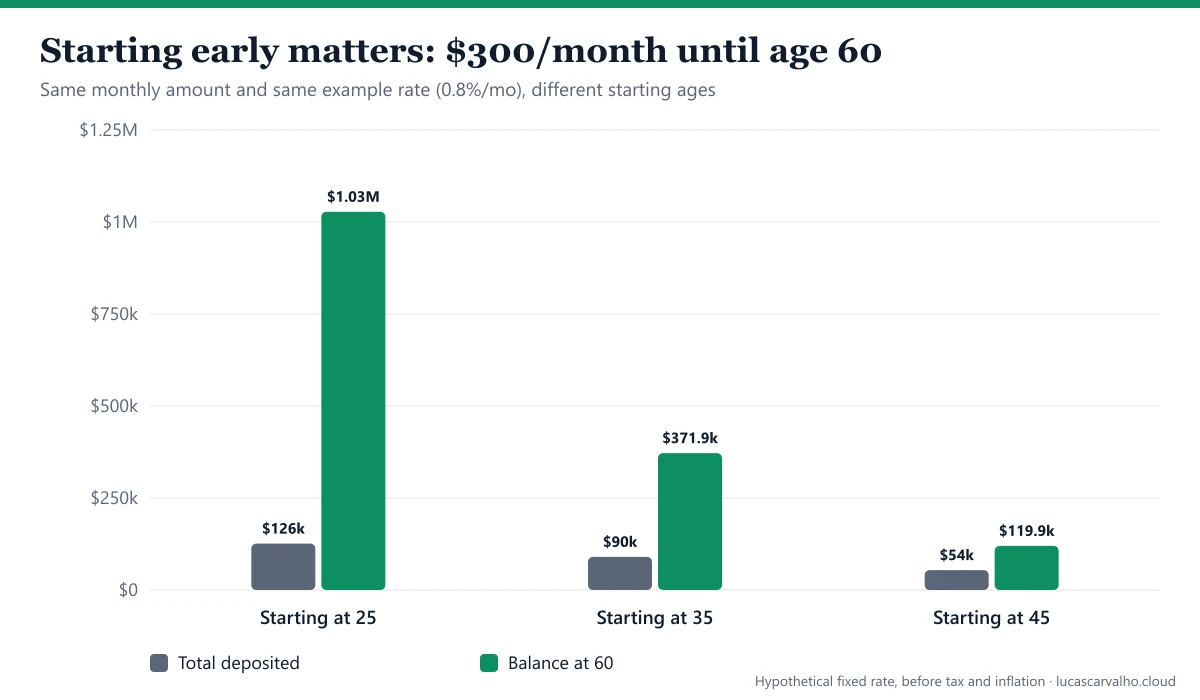
Three people save $300 a month until age 60, at the same example rate (0.8% a month). The only difference is when they started:
| Started at | Total deposited | Balance at 60 |
|---|---|---|
| 25 | $126,000 | ≈ $1,027,758 |
| 35 | $90,000 | ≈ $371,941 |
| 45 | $54,000 | ≈ $119,872 |
The person who started at 25 deposited only $36k more than the one who started at 35 — but ended with almost three times as much money. Those extra ten years of interest on interest make all the difference.
The rule of 72
A mental shortcut to see how long it takes money to double: divide 72 by the annual interest rate.
- At 6% a year → 72 ÷ 6 = 12 years to double.
- At 10% a year → 72 ÷ 10 = 7.2 years.
- At 12% a year → 72 ÷ 12 = 6 years.
It works the other way too: a debt at 12% a month (common on revolving credit in some countries) doubles in about 6 months.
The dark side: compound interest on debt
The same mechanism works against you when you owe. Revolving credit card and overdraft interest are among the highest rates around, and they compound too: unpaid interest is added to the balance and starts generating new interest.
That is why the usual order is:
- Build a small emergency fund so you don't fall into revolving debt.
- Pay off expensive debt first.
- Only then invest, so compound interest works for you.
Three caveats about simulations
- Inflation: $415k thirty years from now will not buy what it buys today. To compare, look at real returns (what you earn above inflation).
- Taxes and fees: income tax, management and custody fees reduce the final result.
- Rates are not fixed: returns go up and down over time. A simulation is an estimate, not a promise.
FAQ
Is compound interest only about investing? No. It is in mortgages, loans, credit cards and overdrafts. Understanding it helps you invest and avoid expensive debt.
Do I need a lot of money to start? No. As the charts show, time and consistency matter more than the amount. Starting small and increasing gradually already makes a difference.
How do I convert an annual rate to monthly? Use (1 + annual rate)^(1/12) − 1. Example: 10% a year ≈ 0.797% a month. Dividing by 12 gives an approximation that is slightly too high.
Conclusion
Compound interest is not magic: it is time + consistency + interest on interest. Start with what you can, organize your budget with the 50/30/20 rule so you have a fixed amount for the future every month, and let time do the heavy lifting.
Note: this article is educational and is not a recommendation to buy or sell any investment. Figures and rates are examples and may change. Financial decisions are personal — if needed, talk to a certified professional.