The 50/30/20 rule: how to split your paycheck and have money left every month
In this article
"My paycheck comes in and disappears." If you have ever said that, you are not alone. Most of the time the problem is not just a low income: it is not having a plan for the money before it arrives. The 50/30/20 rule is the simplest way to build that plan — you can understand it in a minute and apply it today.
What the 50/30/20 rule is
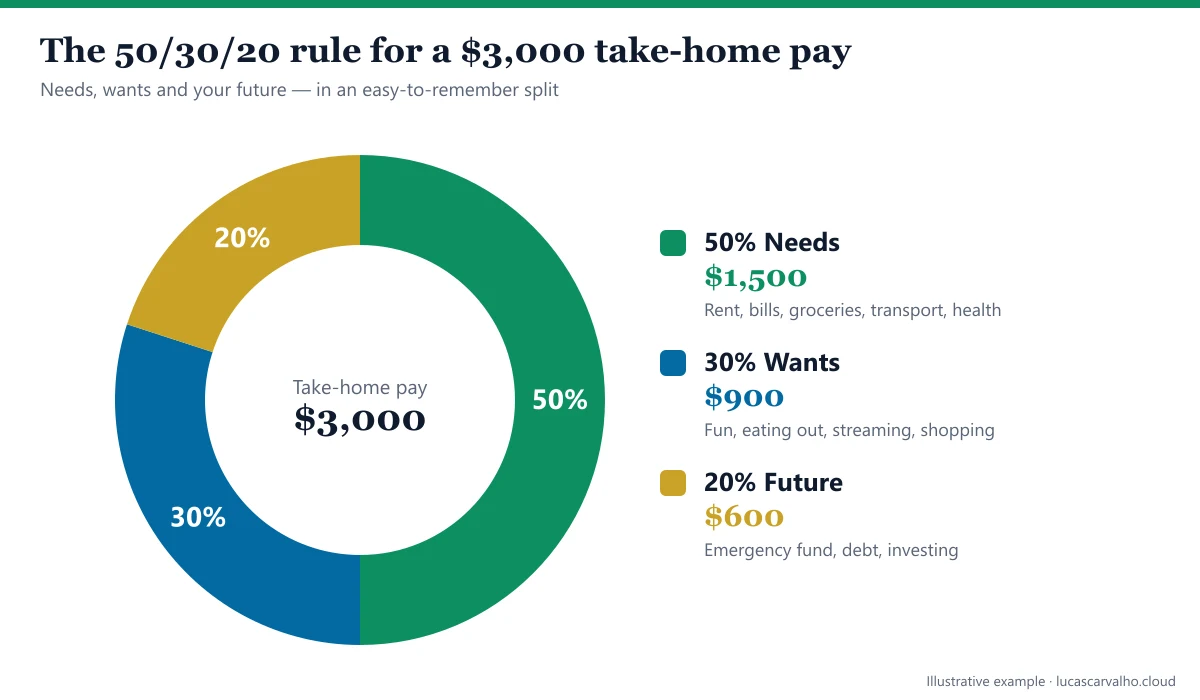
The idea, popularized by U.S. Senator Elizabeth Warren in the book All Your Worth, splits your take-home pay (what lands in your account after taxes and deductions) into three parts:
- 50% for needs: what you must pay to live.
- 30% for wants: what makes life nicer but can be cut.
- 20% for your future: emergency fund, paying off debt and investing.
Here is how it looks on a $3,000 take-home pay:
What goes in each bucket
| Bucket | Examples | Question to classify |
|---|---|---|
| Needs (50%) | Rent or mortgage, utilities, basic internet, groceries, commuting, health insurance, medicine, school, minimum debt payments | "If I stop paying, do I have a serious problem?" |
| Wants (30%) | Eating out and delivery, streaming, gym, travel, clothes beyond basics, a new phone, hobbies, gifts | "Can I live without it, even if I don't want to?" |
| Future (20%) | Emergency fund, extra debt payments, investing, retirement | "Does this improve my life a few years from now?" |
Watch the gray areas: internet is a need, but the premium plan is a want. Groceries are a need; the imported wine in the cart is a want. Be honest when classifying — that is what makes the method work.
Examples at different incomes
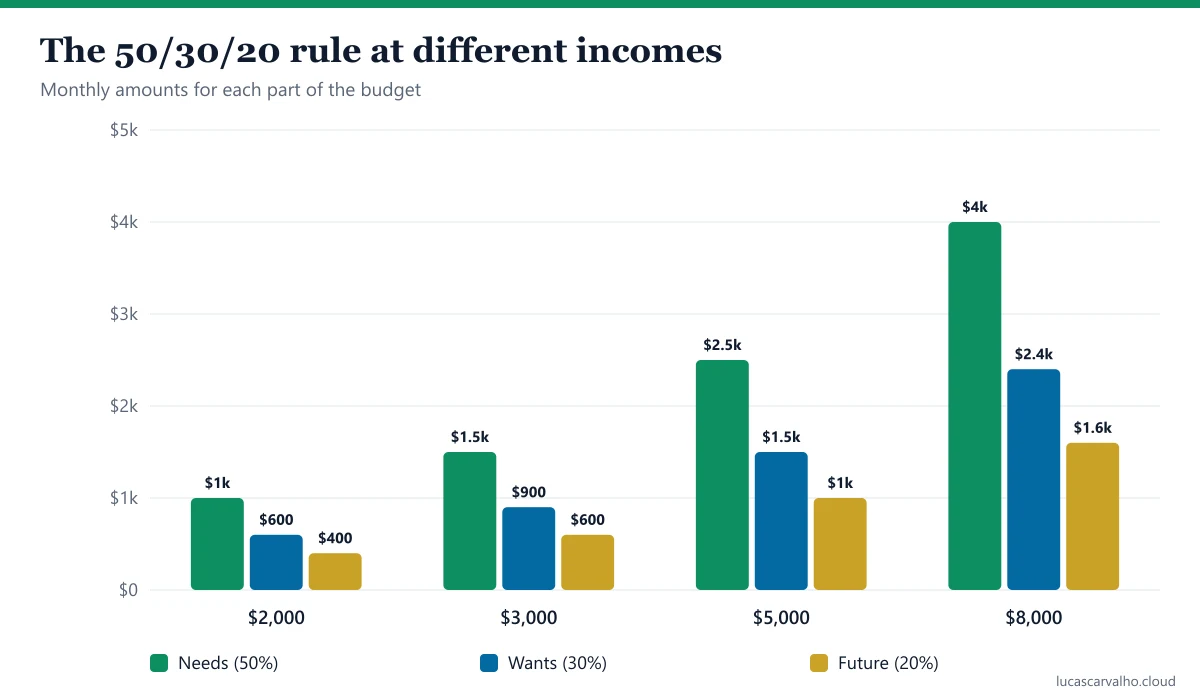
The split is always proportional. Here are the monthly amounts for a few take-home pay levels:
| Take-home pay | Needs (50%) | Wants (30%) | Future (20%) |
|---|---|---|---|
| $2,000 | $1,000 | $600 | $400 |
| $3,000 | $1,500 | $900 | $600 |
| $5,000 | $2,500 | $1,500 | $1,000 |
| $8,000 | $4,000 | $2,400 | $1,600 |
How to apply it in 4 steps
- Work out your take-home pay. Use what actually comes in. If your income varies, use the average of the last 6 months — or your worst month, to be safe.
- List and classify your spending. Take last month's statements and tag each item N (need), W (want) or F (future).
- Compare with 50/30/20. Add up each group and check the percentages. A first result like 65/30/5 is normal.
- Adjust and automate. Move the 20% for the future on payday, with an automatic transfer to another account. What is left is what you have to live on.
Practical tip: many people use three accounts (or savings "pots") — one for needs, one for wants and one for the future. That way you always know how much fun money is left this month.
What if the numbers don't fit?
For many families, rent, groceries and transport alone already exceed 50% of income. That does not mean the method fails — it means it needs adapting:
- 70/20/10: 70% needs, 20% wants, 10% future. A good starting point when fixed costs are high.
- 60/30/10 or 60/20/20: common variations while you reorganize.
- Start with 5% for the future and add 1 point every month or with every raise.
What matters is that there is always a slice for the future, however small. If needs are far above 50%, go after the big costs: housing, car, phone plan, bank fees and debt interest.
Where the 20% should go
An order that usually makes sense:
- Mini emergency fund (1 month of living costs).
- Pay off expensive debt (revolving credit cards, overdrafts).
- Finish the emergency fund (3 to 12 months — see the emergency fund guide).
- Invest for long-term goals, letting compound interest do its work.
Common mistakes
- Using gross pay instead of take-home pay: the numbers become unrealistic.
- Hiding wants inside needs: delivery every night is not "basic food".
- Leaving the future for the end of the month: if it is "whatever is left", there is rarely anything left.
- Quitting after one bad month: budgeting is ongoing adjustment, not a test.
FAQ
Where do installment purchases go? It depends on what you bought. A fridge on installments is a need; a game console is a want. Minimum payments on overdue debt are needs, and extra payments are future.
Does it work for couples? Yes. Apply it to your combined income or each to your own, with a joint account for household needs.
What if I earn very little? Use adapted percentages (70/20/10 or even 80/15/5) and also focus on growing your income. The habit of setting something aside matters more than the amount at first.
Conclusion
The 50/30/20 rule is not a law — it is a map. It shows where your money goes and gives each part a clear target. Start today: work out your take-home pay, classify last month's spending and schedule the future transfer for your next payday.
Note: this article is educational and is not a recommendation to buy or sell any investment. Figures and rates are examples and may change. Financial decisions are personal — if needed, talk to a certified professional.